You are here:
Auto-Feed Blind Rivet Machine Brands: 2026 Top 10 List - Antec
Which pneumatic rivet gun brand is best is a question buyers keep asking in search bars and industry chat groups. There is no shortage of rankings, but few are objective: some pass rebadged tools off as imports, others push one brand from beginning to end. This guide sorts the mainstream brands you can actually buy into tiers, separates imported, Chinese, and entry-level manual tools, and gives recommendations for occasional use, small batches, and full production lines, where the decision usually comes down to an auto-feed blind rivet machine.
For cabinets, chassis and enclosures, an auto-feed machine and a pneumatic gun usually handle the whole rivet range at 50-60 rivets per minute. Everything below applies to pneumatic rivet gun work in that shop-floor setting.
In short, for sheet metal and enclosure plants: pneumatic rivet gun brand tiers at a glance; tier 1: the established import brands; tier 2: chinese brands built for production lines; tier 3: entry-level manual tools.
The Short Answer: There Is No Single Best Pneumatic Rivet Gun, Only the Right One for Your Line
Rivet guns, also called rivet machines or riveters, split by power source into manual, pneumatic, and auto-feed, and by application into aerospace, auto repair, sheet metal, and appliances. Every combination points to a different choice, which is why a ranking can only sort brands into tiers. The bigger the batch, the less anyone argues about which gun feels better in the hand; what matters is who feeds the rivets, how fast the cycle runs, and who absorbs the cost of a missed rivet. That is exactly where an auto-feed blind rivet machine earns its place.
| Power / Feeding | Rivet Pick and Load | Cycle Time | Typical Batch |
|---|---|---|---|
| Manual pneumatic rivet gun | Fully manual, two-hand squeeze | Slow and tiring | Odd jobs, home use |
| Pneumatic rivet gun | Rivet placed by hand, broken off pneumatically | About 1 rivet per second, capped by hand speed | Small to medium batches, repair work |
| Auto-Feed Blind Rivet Machine | Rivets sorted automatically and blown to the nosepiece | About 50-60 cycles/min on standard models, steady enough to plan capacity backward from the ship date | High-volume dedicated lines, automated production |
1. Pneumatic Rivet Gun Brand Tiers at a Glance
| Tier | Representative Brands | Positioning | Common Industries |
|---|---|---|---|
| Tier 1: Imported Specialists | GESIPA, STANLEY/POP Avdel, HUCK, LOBSTER | Proven reliability and mature channels, at a high price | Aerospace, high-speed rail, wind power, automotive parts |
| Tier 2: Strong Chinese Brands | Antec (auto-feed blind rivet machines) and mainstream Chinese pneumatic guns | Strong value, fast response, a full range of automated models | Cabinets, sheet metal, appliances, volume lines |
| Tier 3: Entry-Level Manual | Unbranded tools from small regional shops | Cheap, with inconsistent quality control | Home use, temporary jobs |
Commissioning on site is where the feed rate and the fixture get matched to the panel.
2. Tier 1: The Established Import Brands
GESIPA (Germany): A veteran German riveting manufacturer whose pneumatic rivet guns and pneumatic rivet nut guns are both well known in the industry, with reliability as the selling point. Its tools show up in aerospace, rail transit, and automotive parts. The pneumatic guns feel solid and resist overheating, but they are expensive and spare parts take time to arrive. If you run high-end batches with strict consistency requirements, start here.
STANLEY / POP Avdel: STANLEY is an American tool giant, and POP Avdel, its riveting arm, was one of the pioneers of the blind rivet. You see these tools often on automotive parts lines. STANLEY has a wide dealer network and easy after-sales support, and its range covers manual through pneumatic.
HUCK, CHERRY, LOBSTER: All are imported brands you can buy through normal channels. HUCK built its position on lockbolt (Huck bolt) systems for bridges, wind turbines, and heavy vehicles; CHERRY's aerospace pneumatic rivet guns are classics; LOBSTER comes from Japan, and its manual and pneumatic tools are light and compact, which Asian factories appreciate.
The shared problem with imported guns is price and slow spare-parts service, and they are almost always a single tool fed by hand. However good the gun is, the day's output ceiling still sits with the operator.
3. Tier 2: Chinese Brands Built for Production Lines
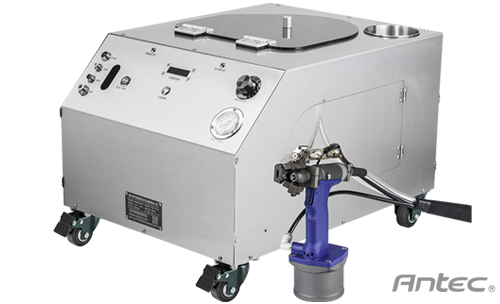
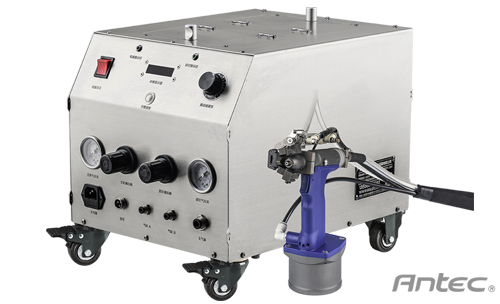
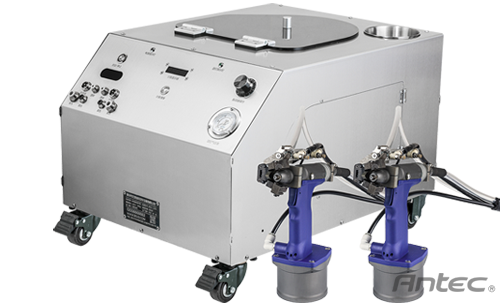
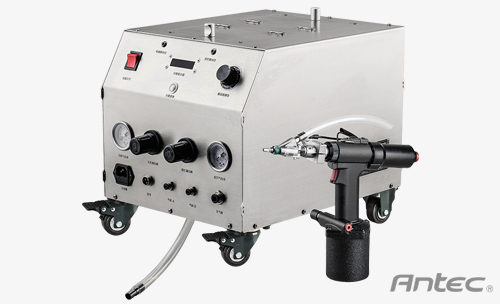
Antec (ANTEC): Based in Huizhou, with 16 years of in-house development and manufacturing. What Antec sells is not one pneumatic rivet gun but a complete auto-feed blind rivet machine. The factory designs and builds its own machines, offers an optional dual-gang dual-gun setup, and integrates with robotic riveting cells. The operator positions the workpiece and pulls the trigger, and the blind riveting is finished, with no rivet picking or loading. Standard models run about 50-60 cycles/min, one machine typically covers the repetitive work of about 3 riveting operators, and missed rivets, pull-through, and uneven cap seating drop sharply. The company has served 1369+ enterprises, every machine carries a 1-year warranty with a 7-day return and 15-day exchange, standard models ship the same day from stock, and engineers can bring a machine to your plant for a free trial riveting run.
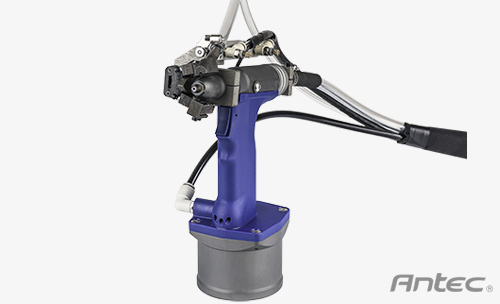
| Item | Standard Manual or Pneumatic Rivet Gun | Antec Auto-Feed Blind Rivet Machine |
|---|---|---|
| Rivet pick and load | Every rivet picked and loaded by hand | Vibratory bowl feeder sorts rivets and blows them to the nosepiece |
| Finished-part consistency | Depends on feel; missed rivets and pull-through happen | Uniform stroke and pull force, even rivet points |
| Cycle time | Varies with the operator's condition | About 50-60 cycles/min on standard models, steady enough to schedule |
| Upgrade path | None left | Handheld, fixed, dual-gun, and robot-arm setups can be layered on |
| Price and lead time | Cheap, ready to use out of the box | A whole-machine investment that pays back in two to six months, available from stock |
| Staffing | One operator, one gun, repetitive work | One operator runs several machines or covers multiple stations |
As the source manufacturer, Antec can add a dual-gang dual-gun setup, a fixed workstation, or a robot-arm riveting cell to a standard machine and integrate it around your workpiece layout, so you do not have to assemble equipment from third parties.
Selection checklist:
- Loading method and rivet locations, and whether the machine must talk to a robot arm
- Budget and payback period, and whether to send samples for a trial riveting run before deciding
- Air supply, station layout, and operating space at your plant
- Rivets per part and daily output, which decide between a single gun, a dual gun, and a dedicated machine
- Whether you need a digital display or MES integration for output reporting and traceability
Some contract-manufactured white-label guns sell at very low prices. They are fine for occasional single-tool use, but quality control is inconsistent, so they are not recommended for a production line. For the trade-offs between Chinese and imported tools, see how Antec has built its own machines for 16 years as a source factory; on rush orders, Chinese stock availability and response time win.
For cabinets and chassis, a trial on your own panels settles more than a specification sheet.
4. Tier 3: Entry-Level Manual Tools
A manual pneumatic rivet gun is closer to a consumable: cheap to buy, enough for hanging a shelf at home or riveting a few spot repairs, and an unbranded tool does the job. For long-term use and volume, look at Tier 2 and above. If you already own manual guns and want to move to auto-feed, see whether existing manual pneumatic rivet guns can be paired with just an auto-feed main unit.
5. Which Tier Fits Which Application
| Application | Recommended Tier | Notes |
|---|---|---|
| Aerospace, high-speed rail, wind power | GESIPA, HUCK, POP Avdel | Reliability comes first; there is no room for rework |
| Occasional home use, repairs | Any manual tool | No need for equipment if you rivet only a few times a year |
| EV battery trays, energy storage cabinets | Auto-feed machine plus robot-arm cell | Cold riveting avoids distortion, keeps rivets traceable, and reduces staffing |
| Auto modification, auto repair | STANLEY, LOBSTER, Chinese pneumatic guns | Scattered rivet points and medium batches; choose by budget |
| Enclosures and cabinets, sheet metal, signage, appliances | Antec auto-feed blind rivet machine | Many rivet points and uniform specs; one machine replaces 3 operators and pays back fast |
What signals that it is time to move from manual guns to automated equipment? Trouble hiring, heavy rework from missed rivets, rush seasons that squeeze lead times, and customers demanding consistency and traceability. If two of those apply, the total cost is worth calculating; see when it pays to move up to an automatic riveting machine.
6. More Important Than the Brand: Test the Auto-Feed Blind Rivet Machine with Your Own Parts
A ranking only narrows the field. Whether a model fits still comes down to the rivet spec, where rivet diameter, material, length, and head size all have to line up. Before you buy, write down the spec, material thickness, rivets per part, and daily output, then have the supplier run your real workpieces and measure cycle time, feed success rate, and pull-out force on the spot. That is worth more than ten rankings. For selection criteria, see how to choose an auto-feed rivet machine; standard models ship from stock, and a free on-site machine trial is available.
Selection FAQ
Practical Q&A
Jams are rare in normal riveting. The sorting bowl is cut to the rivet spec and paired with photoelectric sensors that alarm on a missing or doubled rivet. Give the supplier your rivet specs so the tooling matches, run standard-quality rivets, and continuous feeding stays stable.
On ordinary pneumatic rivet guns there is no real generation gap anymore. Imported tools are slightly better finished and use slightly better materials, but they cost several times more. The real separation now is in complete auto-feed systems and in how fast a supplier can ship from stock, and Chinese manufacturers are closer to the ground on both.
A manual gun costs from a few dozen to a few hundred, a pneumatic gun from a few hundred to a few thousand, and auto-feed is a whole-machine investment. Once you count labor, rework, and lost cycle time, high-volume lines usually pay it back in two to six months.
For similar specs, swap the nosepiece and adjust the feed track. Wide variations need multiple tracks or multiple machines. Send the supplier your rivet list for evaluation; ten sample rivets are enough to judge the same day.
Start with an auto-feed main unit or a dual-gang dual-gun setup at the station with the most rivet points and the tightest cycle. Upgrade step by step from handheld to fixed to robot cell, without disrupting current deliveries.
Pneumatic Rivet Gun at a glance: 12,800 N pull force, 50-60 rivets per minute, in stock with fast dispatch, on-site commissioning and parts supply.
If the rivet size and sheet thickness are known, the team can name the model and the air requirements in one reply.
Standard factory work, mainstream pneumatic equipment
Tell us the rivet range and the output target. We will confirm the model, the 50-60 rivets per minute rating, the parts supply and the on-site commissioning.
Further reading: 5 pitfalls to avoid when buying an auto-feed rivet machine · how to choose the right auto-feed rivet machine model · auto-feed blind rivet machine product center
 Previous
 This is the last article