You are here:
Pneumatic Rivet Nut Gun: Uses, Working Principle and FAQ
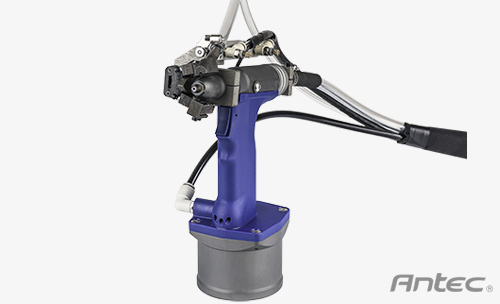
A rivet nut, also called a blind nut or threaded insert, is a fastener built for sheet metal and tube. It forms a reliable internal thread in the panel so ordinary screws can be fitted and removed again and again. An pneumatic rivet nut gun is the machine that automates the process. First-time buyers ask three things: which products it suits, how the nut actually forms, and what to do when something goes wrong. This article answers all three.
The pneumatic line is what most plants run day to day - smooth feeding, easy air-line maintenance and parts that are always available. Everything below applies to pneumatic rivet nut gun work in that shop-floor setting.
In short, for sheet metal and enclosure plants: uses: solving the thread problem in sheet metal; working principle: the five-step forming cycle; rivet nuts vs other thread options for sheet metal; common problems and their causes.
1. Uses: Solving the Thread Problem in Sheet Metal
Tapping a thin panel (usually a few millimeters or less) gives only a few thread turns, and those threads strip easily. Weld nuts bring heat distortion, weld spatter and cold welds, and they cannot be used at all where the back side is out of reach. A rivet nut grows a threaded seat in the panel by cold forming instead, and that gives it four advantages nothing else matches: it installs from one side, even on a closed box section; as a cold process it causes no heat distortion and does not damage the surface finish; the internal thread can be used with screws again and again; and it can be installed after painting or powder coating, so the thread never gets clogged with coating.
| Industry | Typical parts |
|---|---|
| Automotive and parts | Interior brackets, dashboard frames, bumper brackets, battery pack structural parts |
| Enclosures, cabinets and power distribution cabinets | Server chassis, telecom cabinets, doors, mounting plates, shelf fixings |
| New energy | Battery trays, PV frames, energy storage cabinets |
| Home appliances and kitchen equipment | Microwaves, air conditioners, washing machines, range hood shells and internal brackets |
| Sheet metal and aluminum fabrication | Aluminum panels, square tube frames, elevator parts, display fixtures |
2. Working Principle: The Five-Step Forming Cycle
Step 1: the nuts are sorted automatically and threaded onto the mandrel at the nose. Step 2: the nose is aligned with the prepared hole and pushed in square, so the nut body passes through the hole. Step 3: the pull starts and the nose draws axially, so the nut bulges on the back of the panel and clamps the surface. Step 4: the pull force is held so the deformation sets into a solid threaded seat. Step 5: the mandrel reverses out and one threaded hole is complete, ready for a screw. No welding and no rear-side access are needed anywhere in the cycle.
Pneumatic maintenance is simple, but it is not optional - water in the line is the usual culprit.
3. Rivet Nuts vs Other Thread Options for Sheet Metal
| Option | Advantages | Limitations |
|---|---|---|
| Rivet nut | One-sided installation, no heat distortion, installable after coating, easy to automate | Needs a prepared hole and a dedicated gun |
| Weld nut | High strength, low cost | Heat distortion, spatter, two-sided access, damages the finish |
| Self-clinching nut (PEM) | Flat finish, fast | Needs a press, limited by sheet thickness and hardness, awkward on site |
| Direct tapping | Simplest option | Too few threads in thin sheet, strips easily, not made for repeated assembly |
4. Common Problems and Their Causes
Thread stripping, or a screw that will not tighten: worn mandrel, oversized hole, or material thickness outside the grip range of the nut. Nut not collapsing, or spinning loose: low air pressure, stroke or pull force set too low, or a hexagonal hole that does not match. Dished panel surface: pull force too high, nose not held flat, or sheet too thin. Mandrel stuck in the nut: stripped mandrel threads, a nut that did not form fully, or too little lubrication. Thread not clearing: nut size does not match the mandrel, or the nut spins during the pull. For a structured troubleshooting routine see common pneumatic rivet nut gun faults and installation problems.
Parts are held in stock because a stopped line costs more than the part.
Pneumatic Rivet Nut Gun Uses and Working Principle FAQ
Shop-Floor Questions
Each size covers its own thickness range and the catalog states the grip range. For very thin sheet, choose a smaller size or a dedicated thin-sheet nut; tell the supplier your actual thickness and they will match it.
Yes, and this is exactly where the rivet nut wins. It installs from one side, so nobody has to reach inside.
Tensile and torque strength depend on nut size, material thickness and hole diameter. Rivet nuts are already used in large numbers on automotive and new energy structural parts. For critical load points, specify a hexagonal or structural nut and confirm it with a pull-out test.
A blind rivet makes a permanent joint. A rivet nut creates an internal thread you can drive a screw into again and again. The tooling is similar, the purpose is not; see blind rivet basics.
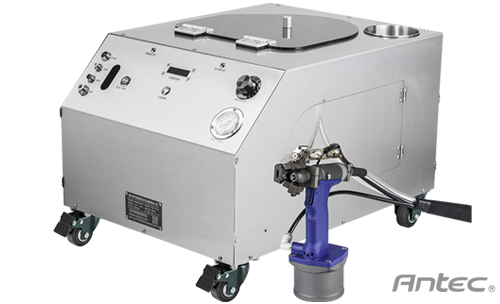
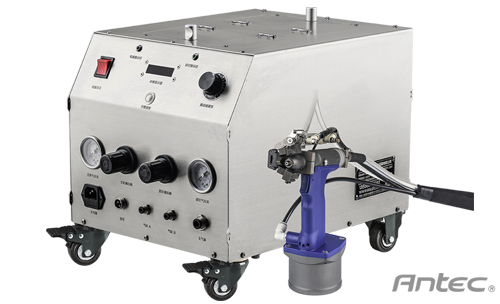
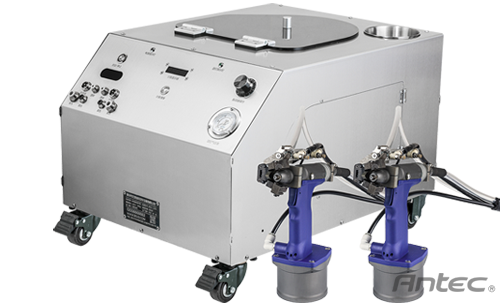
Pneumatic Rivet Nut Gun at a glance: 12,800 N pull force, 50-60 rivets per minute, in stock with fast dispatch, on-site commissioning and parts supply.
Parts are held in stock and commissioning is done on site, so the line starts at the rated 50-60 rivets per minute.
Sheet metal plants: try it on your own panels
Send the rivet size and sheet thickness. We will match the auto-feed machine or the pneumatic gun, then run your panels on site before you decide.
5. Process Data to Confirm Before You Buy
Before asking for a quote or a trial, pull the following together in one pass: panel material and thickness, including the number of stacked layers; the prepared hole, whether round or hexagonal, and its actual diameter; nut size and material, meaning which M size, steel, aluminum or stainless, flat or countersunk head, through-hole or blind; the number of rivet points per part and the annual volume; the screw assembly torque requirement; and any sealing or appearance requirement. The more complete the data, the better the match. The same M6 nut needs a completely different model, pull force and hole size in 0.8 mm cold-rolled steel than in 3 mm stainless steel. With a full data set a supplier can quote a proposal and price range in about 10 minutes; for blind-hole sealing, hex anti-rotation or other special requirements, send sample panels for a test rivet and a pull-out test.
Run a pneumatic semi-automatic gun through the trial phase and lock the nut size and hole positions into the design at the same time. Move to automated equipment when volume production starts, so frequent spec changes do not force repeated changes to feed channels and fixtures.
Further reading: through-hole and blind rivet nuts: key installation points · pneumatic rivet nut guns in sheet metal fabrication · pneumatic rivet nut gun
 Previous